Send the exact assignment or rubric from your classroom and a custom sample written to it lands in 24 to 48 hours, the first one free. BIO-2110 is TESU’s anatomy and Physiology I course. It centers on the biological science that underpins clinical practice, how the body is built and how it works. Below is what BIO-2110 really asks for, where students lose points, and how to use a sample without crossing your school’s lines. Searches like "BIO-2110 module 4 assignment example", "BIO2110 sample paper", and "BIO-2110 module samples" land on this page.
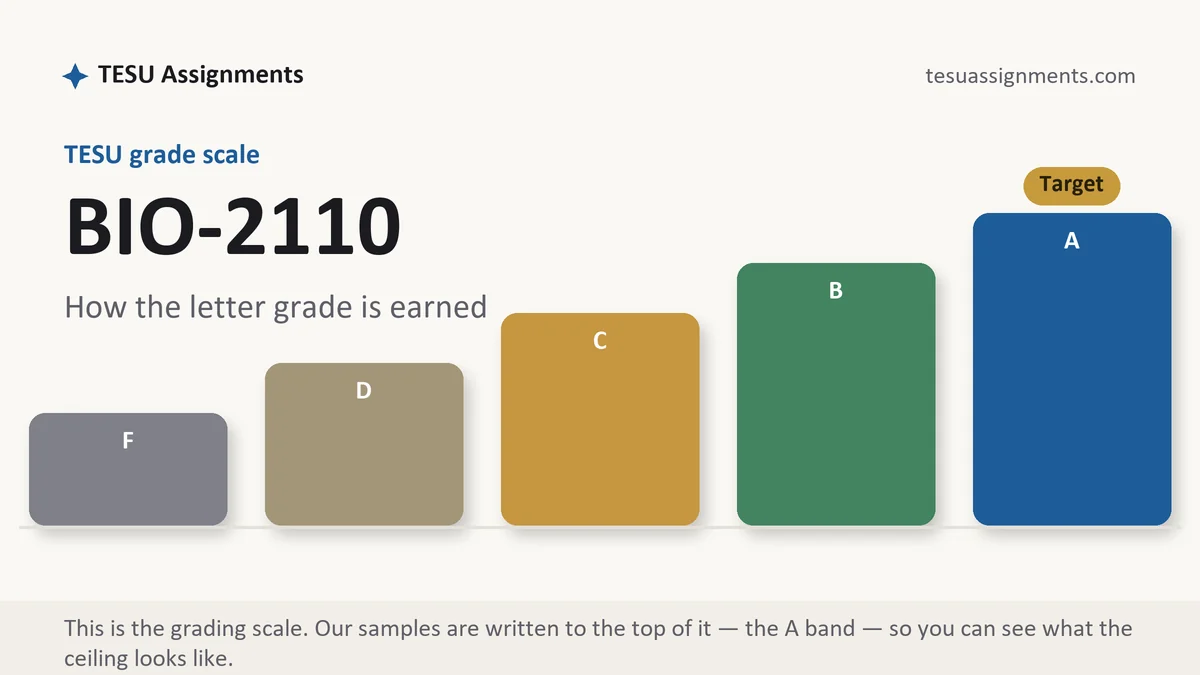
What BIO-2110 is really about
At this level, BIO-2110 is graded on application: the rubric wants you to take the biological science that underpins clinical practice and use it on a real, specific situation, then defend your reasoning with current evidence. Recall alone does not clear the bar, which is why the work below rewards analysis over summary.
What BIO-2110’s assessments ask for
Across most versions of the course, the graded work tends to include:
- concept maps or labeled diagrams.
- quizzes and proctored exams over the material.
- lab reports and lab practicals.
- case-based application questions.
Where students lose points in BIO-2110
The recurring rubric-killers on work like this:
- cramming instead of building the vocabulary over the term.
- memorizing terms without understanding the process behind them.
- thin lab write-ups that skip analysis of the results.
- confusing structures or mechanisms that look alike.
The BIO-2110 drawers
BIO-2110 Module 1 assignment example
A custom sample for this deliverable, written to your exact instructions, free, in 24 to 48 hours.
BIO-2110 Module 2 assignment example
A custom sample for this deliverable, written to your exact instructions, free, in 24 to 48 hours.
BIO-2110 Module 3 assignment example
A custom sample for this deliverable, written to your exact instructions, free, in 24 to 48 hours.
BIO-2110 Module 4 assignment example
A custom sample for this deliverable, written to your exact instructions, free, in 24 to 48 hours.
BIO-2110 Module 5 assignment example
A custom sample for this deliverable, written to your exact instructions, free, in 24 to 48 hours.
BIO-2110 Module 6 assignment example
A custom sample for this deliverable, written to your exact instructions, free, in 24 to 48 hours.
Your classroom shows something different?
Deliverable names and counts shift between course versions. Send what you see and the desk matches it exactly.
Using a BIO-2110 sample the right way
A sample earns its keep as a model: it shows you how a strong BIO-2110 answer is structured, how the rubric rows get covered, how sources are used, and the depth graders expect. Read it, learn the moves, then write and submit work that is your own. Every sample here is custom-written to the instructions you send, and revisions are included until it matches them. Use it to get unstuck and to learn the pattern, and keep to TESU’s academic-integrity policy.
BIO-2110 questions, answered
What kind of assignments does BIO-2110 have?
BIO-2110 typically runs to concept maps or labeled diagrams, quizzes and proctored exams over the material, lab reports and lab practicals, and case-based application questions. The exact mix depends on your course version, so send your rubric and the sample is written to match it.
How fast can I get a BIO-2110 sample, and what does it cost?
A custom BIO-2110 sample written to your own instructions arrives in 24 to 48 hours, and your first one is free. Revisions are included.
Will the sample match my BIO-2110 rubric?
Yes. It is written to the exact instructions and rubric you send, not pulled off a shelf. If your classroom shows different deliverables than the modules listed above, send what you see and the desk matches it.
Is it okay to use a BIO-2110 sample?
Use it the way it is meant to be used: as a model for structure, sourcing, and how a strong answer is built, then write and submit your own work. Always follow TESU's academic-integrity policy.